The Economics of Attention: Why the ‘Unboxing Moment’ is the Last Undervalued Asset in Media


The Inflation of the Digital Gaze
In the modern marketing ecosystem, silence is the most expensive commodity. We live in an age defined by the "Attention Economy," a term coined by Herbert Simon in the 1970s but weaponized by Silicon Valley in the 2010s. For the last decade, the playbook was simple: bid on digital inventory, interrupt the user’s scroll, and hope for a microsecond of cognitive recognition.
But the math is changing. The digital marketplace has become a saturated bazaar of shouting matches. Customer Acquisition Costs (CAC) have risen by approximately 60% over the last five years, while ad fatigue or "banner blindness" has rendered vast swathes of digital real estate invisible to the human eye. We are paying more for eyes that are looking at us less.
At ADbag, we believe the industry is approaching a tipping point. Brands are beginning to realize that an "impression" is not a unit of attention; it is merely a unit of delivery. A pixel fired on a screen is not a synapse fired in a brain.
This necessitates a fundamental re-evaluation of how we price media. It requires us to look away from the infinite scroll and toward the one moment where the consumer’s attention is not only guaranteed but enthusiastically given: The Unboxing Moment.
Deconstructing the Pricing of "Reach"
To understand the value of the ADbag model, we must first dissect the inefficiencies of the models we are replacing.
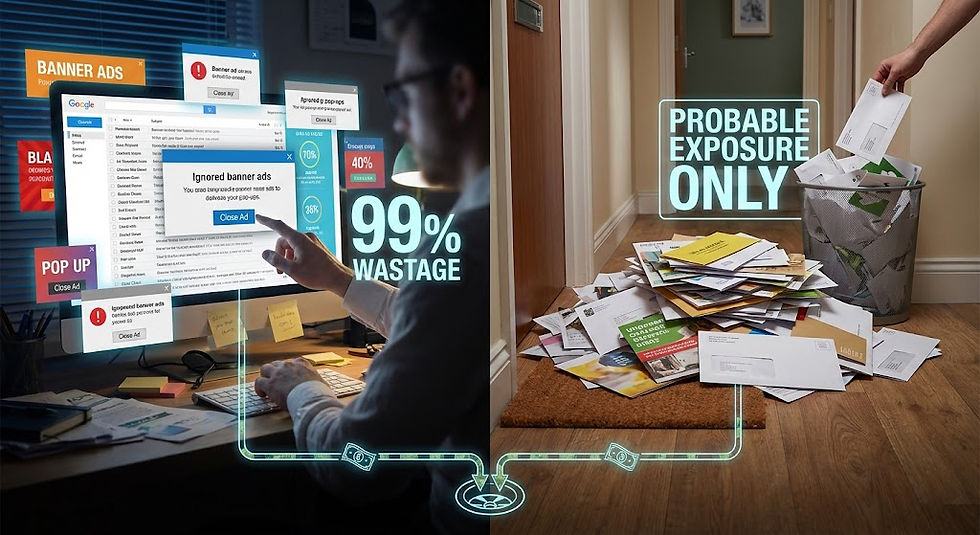
Traditional media buying operates on a model of probable exposure. When you buy a programmatic display ad, you are purchasing the probability that a user will see your creative amidst a chaotic interface. When you buy a traditional Direct Mail (DM) campaign, you are purchasing the probability that a homeowner will pick up a leaflet from their doormat before recycling it.
In both instances, the "wastage", the percentage of paid media that never registers consciously with the prospect: is the silent killer of ROI? You are subsidizing the 99% who ignore you to reach the 1% who don't.
The Direct Mail Paradox
Traditional Direct Mail has historically been a high-performance channel, offering conversion rates often dwarfing digital. However, its pricing structure is burdened by heavy logistics. In a standard DM campaign, your budget is cannibalized by three distinct costs:
Production: The print.
Data: The list.
Logistics: The "final mile" delivery (the van, the postman, the fuel).
Approximately 40% to 60% of a traditional DM budget is spent simply moving the paper from point A to point B. You are essentially a logistics company first and an advertiser second.
The AdBag Paradigm: The Zero-Logistics Advantage
ADbag was founded on a simple question: Why pay for a van that is already going there?
Our model is built on the concept of "Piggyback Economics." Every day, millions of parcels traverse the UK, eagerly awaited by consumers. These parcels are not unsolicited junk mail; they are invited guests. By transforming the packaging itself into a media channel, we eliminate the single most expensive line item in physical advertising: the delivery cost.
When you evaluate ADbag’s pricing, you are looking at a model where the logistics cost is effectively zero. The postage has already been paid by the consumer’s purchase of a dress, a gadget, or a book.
This shift in unit economics allows us to reallocate budget from delivery to quality. It allows us to offer a physical, full-colour, tactile brand experience at a CPM (Cost Per Mille) that competes with fleeting digital impressions, yet carries the weight and retention of a physical billboard.

The Currency of Haptics: Why Touch Matters
Pricing models often fail to account for the quality of the impression. In the digital realm, all pixels are created equal. In the physical realm, they are not.
Neuroscientific research into "Haptics" (the science of touch) suggests that physical media generates a stronger emotional response than digital media. A study by Bangor University and Millward Brown revealed that physical material involves more emotional processing, which is better for memory and brand associations.
When a customer receives an ADBag, they are physically handling your brand. They must touch the bag, tear the strip, and open the package to get to their purchase. This is not a passive scroll; it is an active engagement.
In our pricing structure, we factor in this "Cognitive Premium." We aren't just selling space on a bag; we are selling a dopamine spike. The customer is in a state of high arousal and positive anticipation (the "Unboxing Moment"). Placing your brand message exactly at this neuro-chemical peak is an arbitrage of attention that digital simply cannot replicate.
The "Kitchen Table" Metric
If we were to create a new metric to rival the digital "Click-Through Rate," it would be "Kitchen Table Retention Time."
Digital ads live for seconds. An email lasts until it is deleted. But e-commerce packaging has a unique lifecycle. It enters the home, it lands on the kitchen table or the hallway table, and it stays there. It is often seen by multiple members of the household. It is part of the domestic environment for minutes, hours, or sometimes days.
This "dwell time" is the hidden value in the ADBag pricing model. You are not renting a millisecond of peripheral vision; you are renting prime real estate in the heart of the consumer's home.
Data-Driven Attribution: Closing the Loop
The historical criticism of physical media is the lack of attribution. "I know half my advertising is working," the old adage goes, "I just don't know which half."
ADbag rejects this ambiguity. We position ourselves as a Performance Media Network, not just a branding exercise. Our pricing models are justified by precise, digital-grade tracking capabilities embedded within the physical asset.
Through the use of dynamic QR codes and unique, channel-specific offer codes, we transform the physical bag into a trackable cookie. We can tell you not just how many bags were delivered, but:
The Scan Rate: The physical equivalent of a Click-Through Rate.
The Conversion Rate: The percentage of scans that resulted in a sale.
The Geo-Heatmap: Exactly where in the UK your offer is resonating.
This allows our clients to calculate a true eCPA (Effective Cost Per Acquisition). When you run the numbers, the efficiency of the ADbag model becomes clear. Because the media is landing in the hands of "Active Shoppers" (people who have just transacted online), the intent to purchase is naturally higher than a cold digital audience. You are fishing in a stocked pond.
The Sustainability Dividend
Finally, any discussion on pricing in 2025 must include the cost of conscience. ESG (Environmental, Social, and Governance) criteria are no longer optional for major brands.
The ADbag model offers a "Sustainability Dividend" that is priced into our value proposition. By subsidizing the cost of packaging for our network of Sellers, we enable them to switch to higher-quality, 100% recyclable, and sustainable materials that they might not otherwise afford.
For the advertiser, this means your media spend is doing double duty: it is acquiring customers and subsidizing a greener supply chain. In a world where consumers are increasingly scrutinizing the ethics of the brands they buy from, this is a value-add that cannot be captured in a simple spreadsheet, yet it is fundamental to the long-term equity of your brand.
Conclusion: The Race to Value
The race to the bottom in media pricing is over. The cheapest CPM usually buys the lowest quality attention. The future belongs to brands that understand the difference between reaching a customer and resonating with one.
ADbag represents a return to the fundamentals of advertising: put the right message, in the right hands, at the right time, powered by the logistics and data capabilities of the 21st century.
We invite you to stop paying for the van, and start paying for the view.



Comments